December in a homeschool can go two ways: a rushed month of half-finished lessons and holiday errands, or a slower season where the whole family studies the same story together. An Advent unit study makes the second one possible. You set aside some regular subjects, read Scripture together each day, and let each child respond at their own level.
This guide covers how to plan a multi-age Advent study, how a Jesse Tree works, and how to add Christmas around the world for geography and history. If you want to try a few pages first, the free homeschool pack is a no-cost place to start.
When Advent starts
Advent begins on the fourth Sunday before Christmas. In 2026, Christmas falls on a Friday, so the first Sunday of Advent is November 29, 2026. Because the length of Advent changes every year, most family devotionals and unit studies use a simple count of December 1 through 25 instead. Either works; choose the one that fits your family's church calendar.
How to teach one study to several ages
The key to a multi-age study is to share the content and level the output.
- Read together. Everyone hears the same Bible passage. Younger children can sit with a coloring page or ornament while they listen.
- Discuss at different depths. Ask a simple question of the youngest ("Who did God send?"), a "why" question of the middle children, and an application or connection question of the oldest.
- Write at their own level. Little ones trace a short phrase. Middle children copy the full verse. Older children copy the verse and write a narration, telling back what they learned in their own words.
- Close together. Light a candle, hang an ornament or sing a carol from your hymnal.
| Age | Discussion | Written work |
|---|---|---|
| 6–8 | Who, what, where questions | Trace and write a short phrase; draw a picture |
| 9–11 | Why questions; retell the story | Copy the KJV verse on handwriting lines |
| 12–14 | Connect prophecy to fulfillment; apply it | Copy the verse, then write a narration |
The Advent Unit Study for Multi-Age Homeschool is built this way: 25 daily lessons from December 1 to 25, each following one Old Testament promise of the Messiah to its fulfillment, with a KJV key verse, one discussion question for each of three age groups, and copywork in three levels (75 copywork pages in all). Each day also has a short note from Christmas history.
Prophecy and fulfillment: the backbone of the study
Studying prophecy shows children that Christmas did not begin in Bethlehem. It began with promises made centuries earlier. A simple approach is to read the promise, then read the fulfillment, and ask, "How did God keep this promise?"
- Genesis 3:15, the first promise of a Redeemer
- Isaiah 7:14 and Matthew 1:23, Emmanuel, God with us
- Micah 5:2 and Matthew 2:6, born in Bethlehem
- Isaiah 9:6, the child born and the son given
- Isaiah 40:3 and Luke 3:4, the voice crying in the wilderness
Older children can keep a two-column chart: promise on the left, fulfillment on the right. By Christmas Day it becomes a record of the whole study.
Adding a Jesse Tree
A Jesse Tree takes its name from Isaiah 11:1: "And there shall come forth a rod out of the stem of Jesse, and a Branch shall grow out of his roots." Each day has a reading and a small ornament that tells part of the story, moving from Creation and the Fall through Noah, Abraham, Moses and the kings to Mary, Joseph and the manger.
Ways to make the tree
- A bare branch in a vase or a pot of stones
- A small tabletop tree
- A tree drawn on poster board, with ornaments taped on
Many families do the Jesse Tree in the evening with everyone, including a parent who works during the day, and keep the unit study for morning school time. The Jesse Tree Advent devotional with 25 printable ornaments has a one-page devotion for each day (Scripture reading, KJV key verse, short devotion, questions and prayer) and 25 line-art ornaments about 3.5 inches across for children to color, cut and hang, plus 5 blanks.
Christmas around the world
A Christmas around the world study turns December into a geography unit. Children find each country on a map, learn how Christians there celebrate the birth of Jesus, and stamp a passport. A few traditions to explore:
| Country | Tradition |
|---|---|
| Mexico | Las Posadas, nine nights of processions from December 16 to 24 remembering Mary and Joseph's search for lodging |
| Sweden | St. Lucia's Day on December 13, with candles and a festival of light |
| The Netherlands | St. Nicholas celebrated on the evening of December 5 |
| The Philippines | Simbang Gabi, a series of nine dawn Masses beginning December 16 |
| Poland | Wigilia, the Christmas Eve meal, traditionally begun when the first star appears |
| Ethiopia | Christmas (Genna) celebrated on January 7 |
| Australia | Christmas in summer, often outdoors |
The Christmas Around the World unit study covers ten countries (Mexico, Germany, Sweden, Italy, the Philippines, the Netherlands, the United Kingdom, Ethiopia, Australia and Poland) with a reading page and an explore page for each, a cut-and-fold passport, a world map, Luke 2 copywork in KJV at two levels and a review quiz with answers.
Fitting it into the month
Ten countries fit well at two or three a week through December. Or start it after Christmas and finish with Ethiopia on January 7, which keeps the season going through the twelve days of Christmas.
Connect it to history
Advent is a good time to add entries to a timeline or Book of Centuries: the first nativity scene (1223), the King James Bible (1611), the first performance of Messiah (1742) and the first performance of "Silent Night" (1818). The Book of Centuries and timeline figures set has a two-page spread for every century and 120 timeline cards, so children can add Christmas history to the same book they use all year.
Keep December restful
- Drop or lighten other subjects. Keep math and reading practice short and let the Advent study carry Bible, history, geography and handwriting.
- Use a morning basket. Hymn study, memory verses and a read-aloud fit naturally around Advent. The morning basket starter bundle has 12 weeks of hymn studies (with the story behind each hymn, no lyrics printed) and KJV memory verse copywork.
- Get outside. A winter walk is a good break between lessons. Winter nature study has 12 weeks of birds, evergreens, tracks and the winter sky that carry you from December into early spring.
- Allow catch-up days. If you miss a day, read two the next morning or skip the written work.
A sample Advent day
| Time | Activity |
|---|---|
| Morning, 20 minutes | Bible reading and discussion at three levels |
| Morning, 15 minutes | Copywork or narration at each child's level |
| Late morning, 20 minutes | Christmas around the world country or history note |
| Evening, 15 minutes | Jesse Tree reading, ornament and prayer with the whole family |
Plan it now, print before the first week of Advent, and let December be a month your children remember for the right reasons. Start with the free homeschool pack and add the pieces that fit your family.
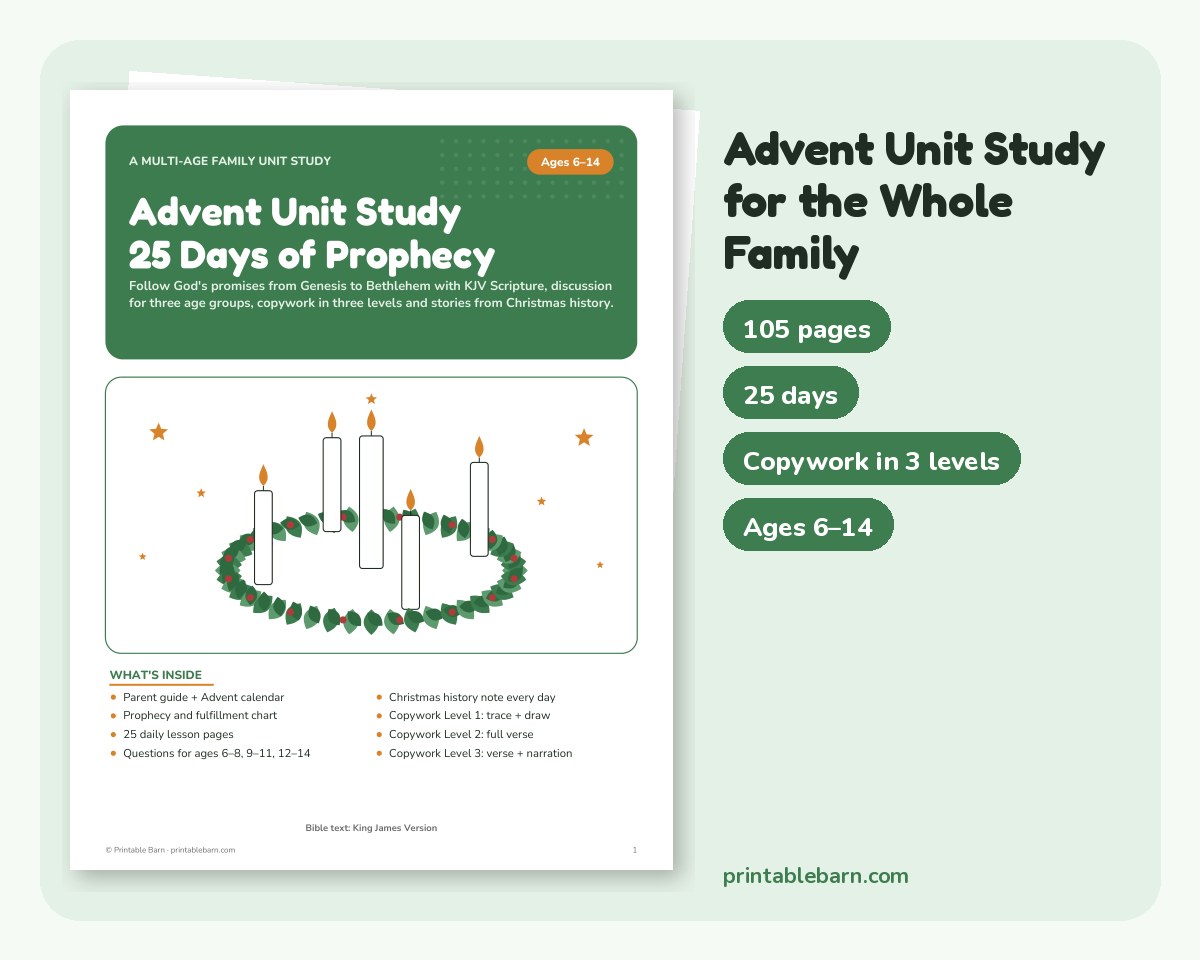 Advent Unit Study for Multi-Age Homeschool: 25 Days of Prophecy, KJV Copywork in 3 Levels and Christmas History (Ages 6–14)
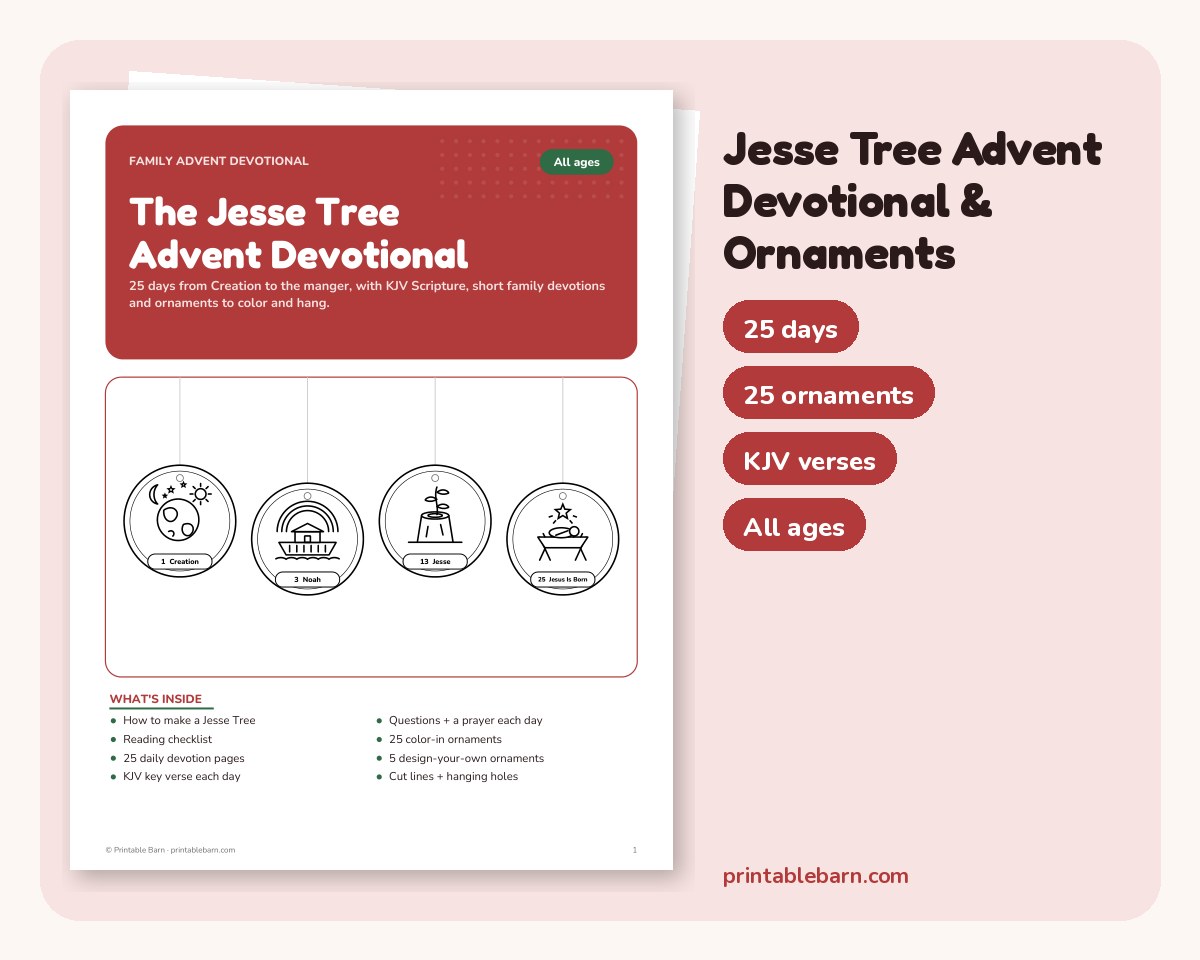 Jesse Tree Advent Devotional with 25 Printable Ornaments: KJV Readings and Family Devotions (All Ages)
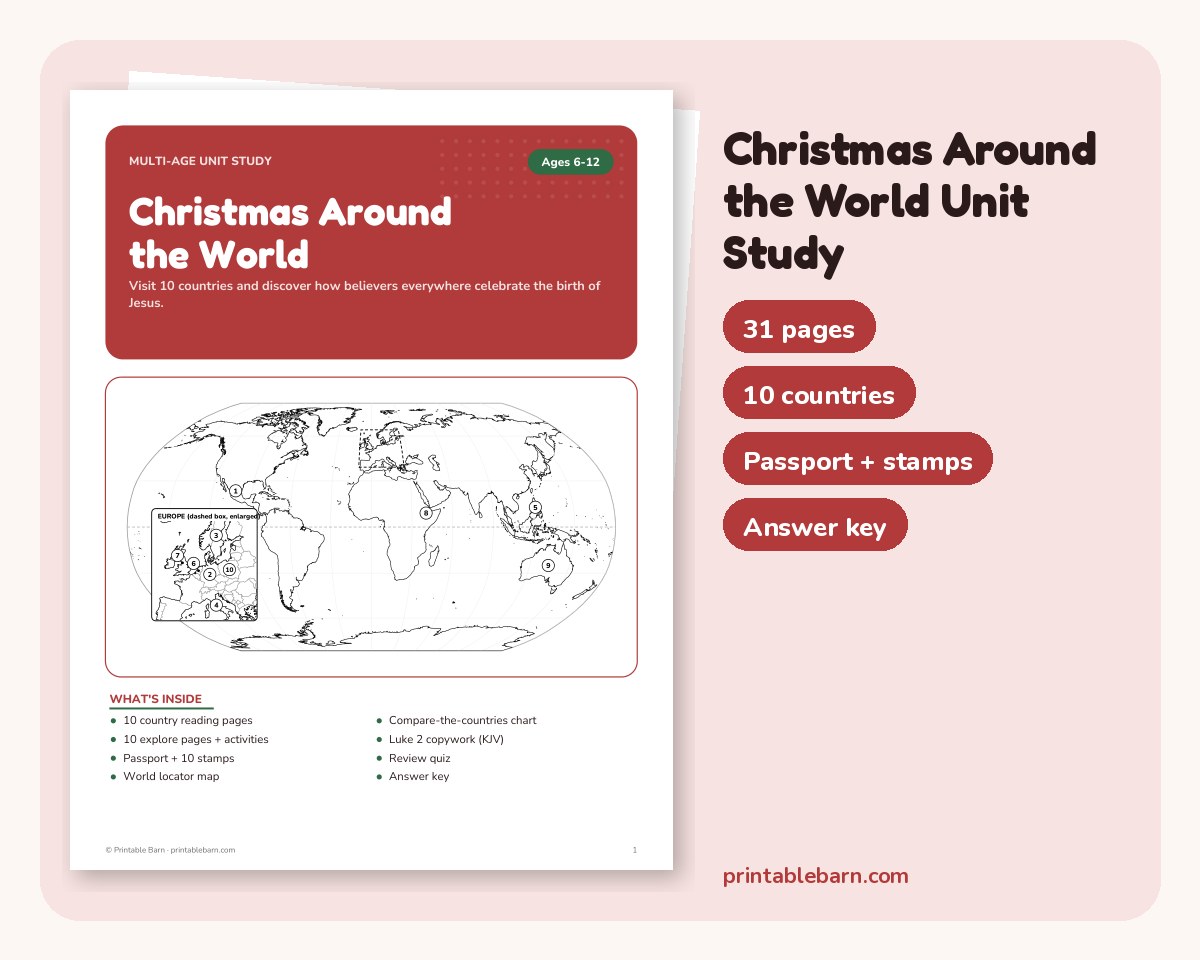 Christmas Around the World Unit Study: 10 Countries with Passport, Map and Luke 2 Copywork (Ages 6-12)
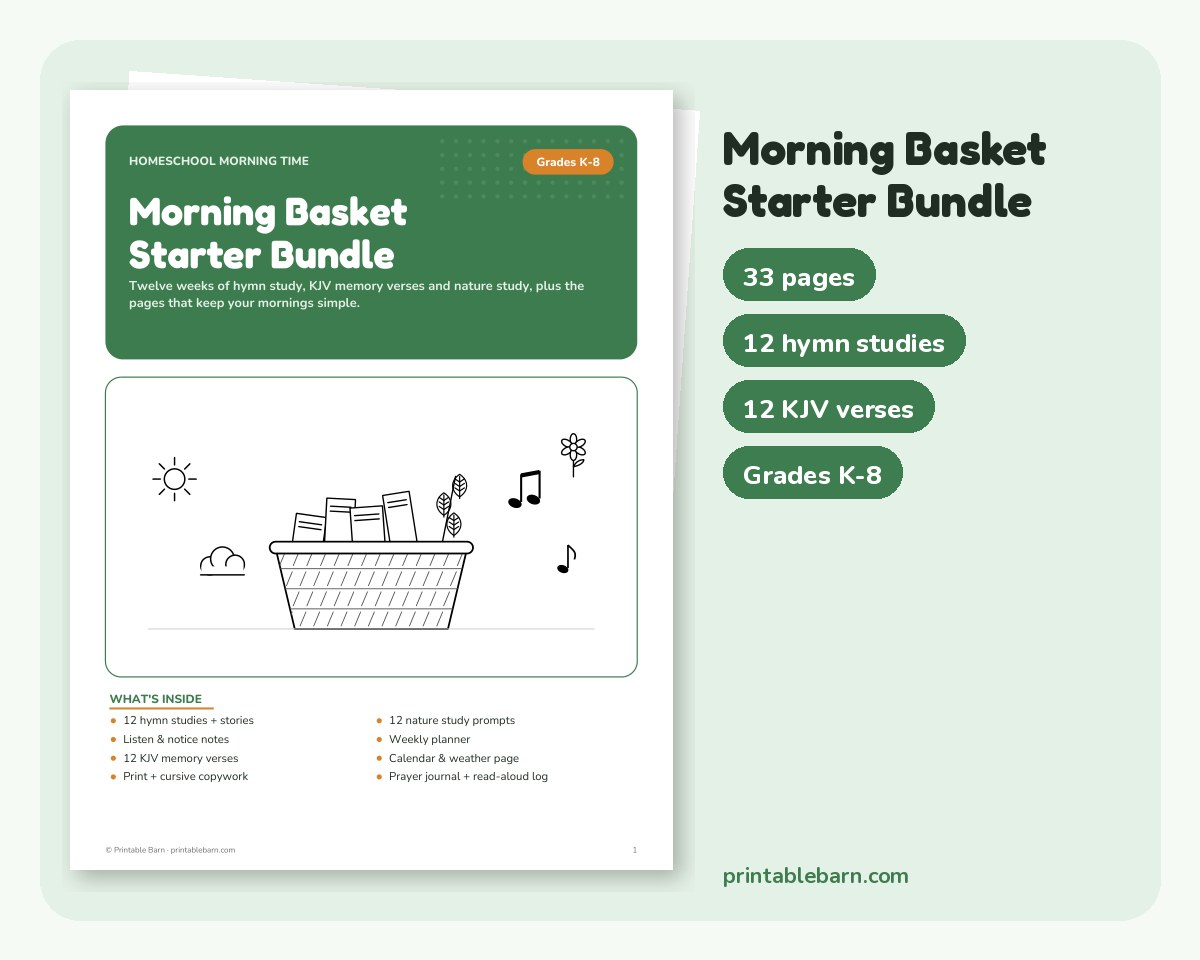 Morning Basket Starter Bundle: 12-Week Hymn Study, KJV Memory Verse Copywork, Nature Study Prompts and Planner (Grades K-8)
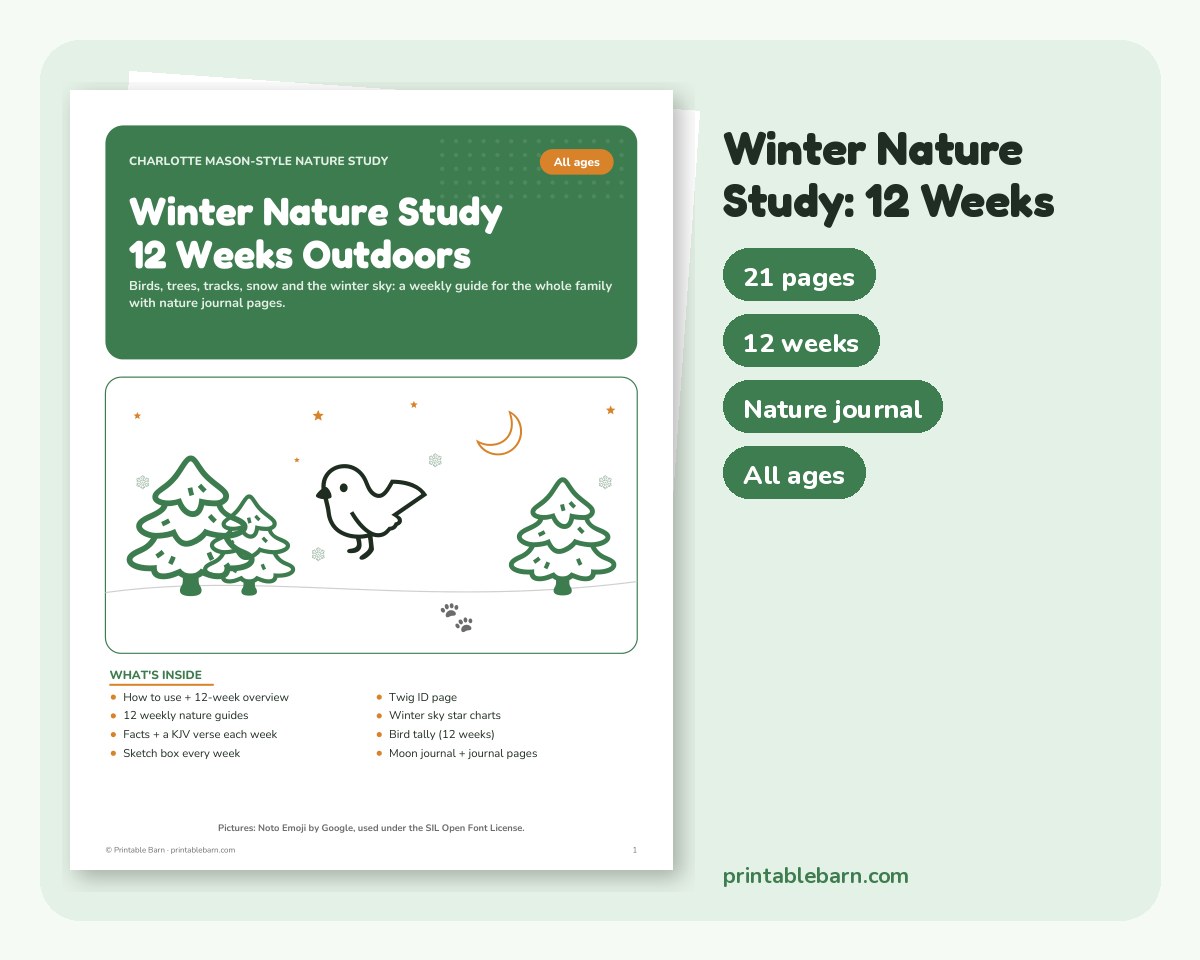 Winter Nature Study for Homeschool: 12 Weeks of Birds, Trees, Tracks and Winter Sky with Nature Journal Pages (All Ages)
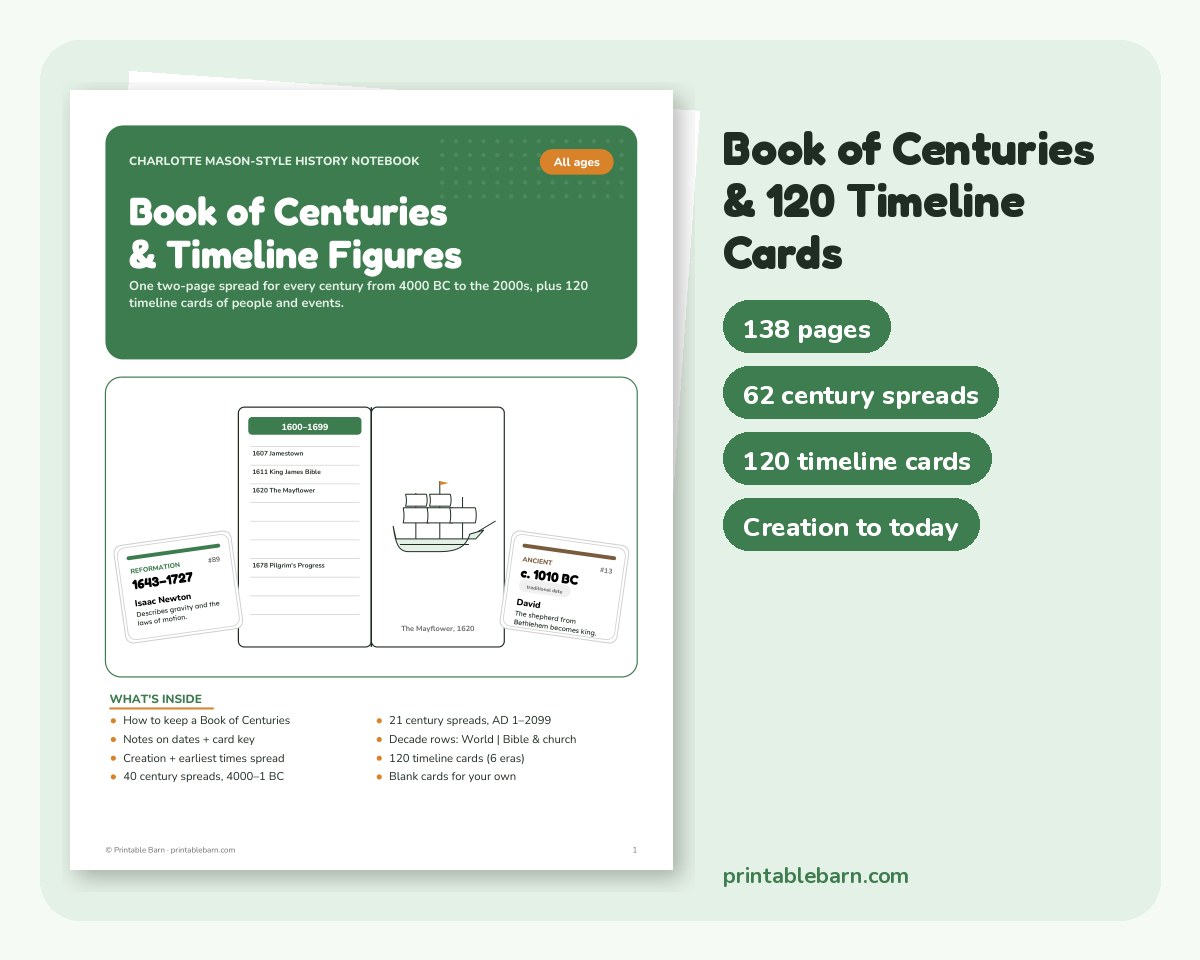 Book of Centuries and Timeline Figures: Printable Pages plus 120 Timeline Cards from Creation to Today