Quick answerFor simple small business bookkeeping, open a separate bank account for the business, record every sale and expense in one ledger (a spreadsheet, app or printed log), keep receipts, and spend 15 minutes a week updating it. At month end, total your income and expenses by category so tax time is mostly done.
⚖️ Please read: This article is general information, not tax, legal or accounting advice. Tax rules, record-keeping requirements and estimated tax obligations depend on your situation; consult the IRS, your state, or a qualified tax professional.
Record every sale and expense, with date, amount, category and note.
Keep receipts (photos are often fine) and organize them by month.
A 15-minute weekly habit beats a scramble in April.
Ask a tax professional about what applies to you.
Bookkeeping sounds intimidating, but for a small or home business it mostly means writing down money in and money out, consistently. Here's a simple system.
Step 1: Separate your money
Open a separate checking account (and card, if you can) for the business. It makes tracking easier and keeps records clean.
Step 2: Pick one place to record everything
A spreadsheet, bookkeeping software or a printed ledger all work. What matters is that everything goes in one place.
Step 3: Record each transaction
Date
Description
Category
Income
Expense
Nov 3
Craft fair sales
Sales
$240
Nov 4
Jars and lids
Supplies
$38
Nov 6
Booth fee
Fees
$25
Common expense categories
Supplies and materials
Packaging and shipping
Platform, payment and booth fees
Advertising
Software and subscriptions
Equipment
Mileage (keep a log of business miles)
Step 4: Keep receipts
Snap a photo of each receipt and save it in a folder by month, or keep paper receipts in a monthly envelope.
The 15-minute weekly routine
Download or check your business bank and payment platform transactions.
Enter anything missing in your ledger.
Match receipts to expenses.
Note any unpaid invoices to follow up.
Monthly and year-end
Monthly: total income and expenses by category; compare to last month.
Quarterly: many self-employed people make estimated tax payments; ask a tax pro whether you should.
Year-end: totals by category, mileage log, and a list of equipment purchases for your tax preparer.
Disclaimer: This article is general information, not tax, legal or accounting advice. Tax rules, record-keeping requirements and estimated tax obligations depend on your situation; consult the IRS, your state, or a qualified tax professional.
Printables that go with this
Every one has a free sample page, so you can print one and try it first.
What is the easiest way to do bookkeeping for a small business?
Use a separate business bank account, record every transaction in one ledger, keep receipts, and update it for about 15 minutes each week.
Do I need a separate bank account for my small business?
It isn't always legally required for a sole proprietor, but it makes bookkeeping much easier and records cleaner.
What records should a small business keep?
Income records, expense receipts, bank and payment statements, invoices, a mileage log if you drive for business, and records of equipment purchases.
How often should I do bookkeeping?
A short weekly session keeps it manageable, with a monthly summary and year-end totals.
About Printable Barn. We make low-cost, instant-download printables (large-print puzzles, bingo, party games, worksheets, planners and Sunday school pages) and free tools like an online bingo caller, a logo maker and a product label maker. Every puzzle is computer-checked, and every product has a free sample page. Questions: hello@printablebarn.com.


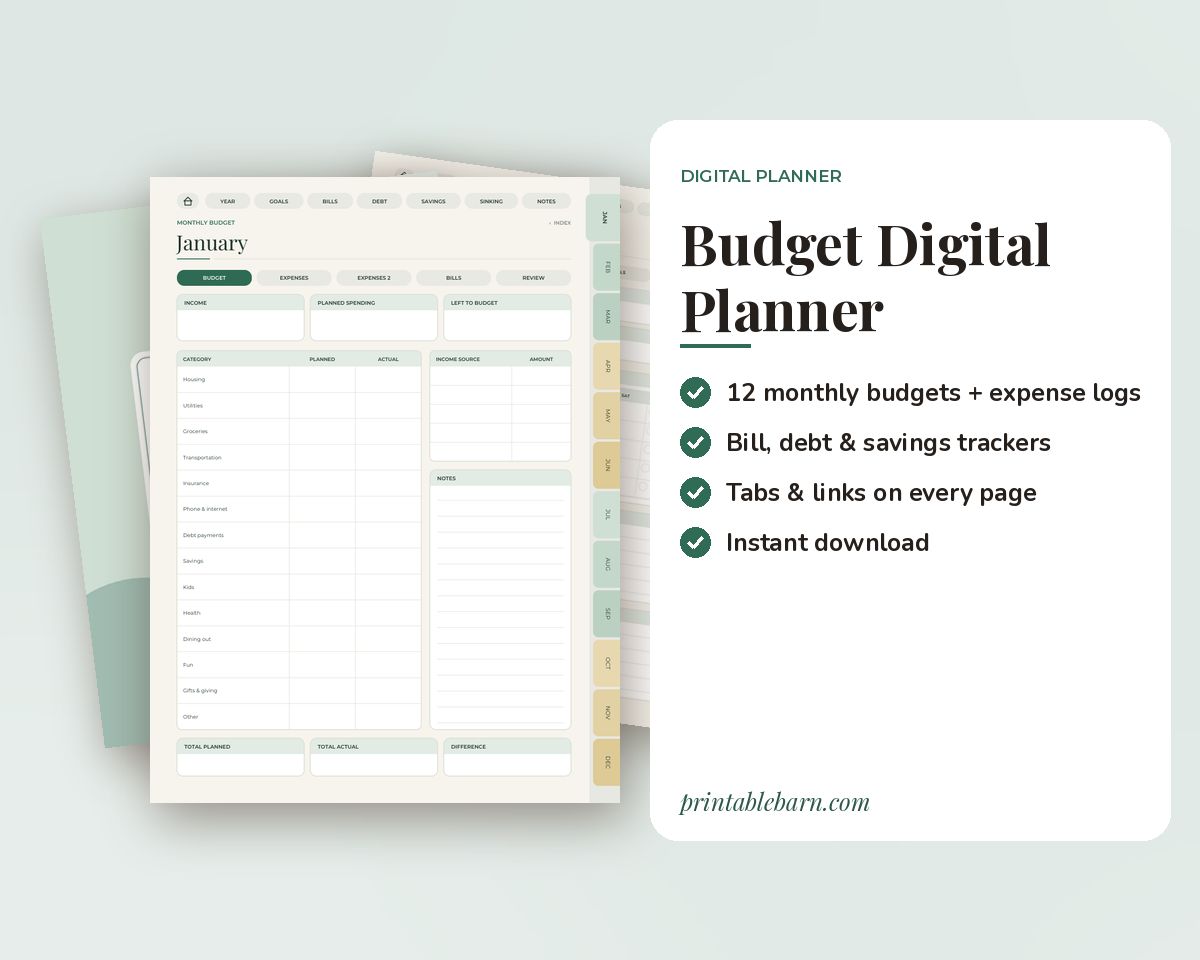 Budget Digital Planner: Undated Hyperlinked iPad Budget Planner for GoodNotes & Notability